Sinner Dominates Zverev Once More at the All England Club
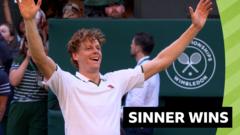
The roar that erupted from Centre Court spoke volumes about what had just transpired. Jannik Sinner, the defending champion, had orchestrated a display of tennis that reminded everyone why he has become one of the sport's most formidable forces. Against Alexander Zverev, a opponent hungry for his first Grand Slam title, Sinner produced the kind of performance that transcends mere statistics—it was a masterclass in precision, athleticism, and mental fortitude that culminated in him retaining his Wimbledon crown.
A Rallying Moment That Defined the Final
In the midst of this compelling encounter on grass's most hallowed ground, one particular rally stood as the symbolic apex of Sinner's superiority. The kind of exchange that tennis aficionados will replay in their minds for years to come, it showcased the Italian's ability to manipulate angles, construct points with mathematical precision, and finish them with devastating power. As the ball found the line and Zverev's shoulders sagged slightly, Centre Court rose to acknowledge not just a winner, but an artist at work. This wasn't simply about winning the point—it was a statement, a crescendo in an already gripping narrative.
The final itself had proven to be far more than a ceremonial coronation. Zverev brought intensity and purpose to the grass courts of southwest London, testing Sinner in ways that suggested the conclusion was anything but predetermined. The German competitor, perpetually searching for that elusive first major title, played with the desperation and precision of someone who knew this might represent his best chance. His serve remained a potent weapon throughout, and his movement across the grass demonstrated the evolution that has occurred in his game over recent seasons.
Defending the Throne: Sinner's Path to Consecutive Titles
What makes Sinner's achievement particularly significant is the rarity of back-to-back Wimbledon victories in the modern era. The grass courts present unique challenges that differ markedly from the clay and hard courts where the Italian has also demonstrated excellence. To win once at the All England Club is an accomplishment that defines careers; to win consecutively speaks to adaptability, consistency, and an almost preternatural ability to elevate one's game precisely when it matters most. Sinner has now joined an exclusive club of champions who have managed the feat, a testament to his technical brilliance and psychological resilience.
The path to this final had not been without its obstacles. Sinner navigated through a brutally competitive draw, facing opponents at various stages of their careers and careers trajectories. Each match represented a test of his preparation, his tactical acumen, and his physical conditioning. By the time he reached the final, there was a sense that he had earned every inch of grass beneath his feet. His opponents had tested him, pushed him to the brink at moments, yet none had been able to find the key that would unlock his seemingly impenetrable defense and explosive offense.
The final itself revealed why Sinner has become the player to beat across multiple surfaces. His serve, often the foundation of his game, functioned as a reliable tool throughout. His forehand—perhaps the most destructive shot in contemporary tennis—remained a constant threat, allowing him to dictate rallies and force Zverev into defensive positions. But perhaps more impressively, his movement and court sense demonstrated an intuitive understanding of angles and positioning that comes only from hundreds of hours of practice and match experience. He seemed to anticipate Zverev's intentions, often arriving at positions before the German had fully committed to his shot.
What makes Sinner's dominance even more noteworthy is the broader context of men's professional tennis. The sport has long been characterized by intensity at the highest levels, with multiple players capable of winning on any given day. That Sinner has managed to establish himself as the favorite on grass—traditionally a surface where consistency is rewarded but surprise victories are still possible—speaks to the completeness of his game and his mental approach to competition. He has not simply inherited a throne; he has claimed it through superior execution.
As the final concluded and Sinner held aloft the trophy once more, the significance of the moment extended beyond Wimbledon's storied traditions. He had proved that his previous year's victory was no accident, no fortunate happenstance, but rather the product of a player with the talent, dedication, and temperament to sustain excellence at sport's highest level. The compelling nature of the final—with Zverev's spirited challenge and Sinner's relentless response—provided the perfect narrative arc for a championship that will be remembered as a defining moment in both players' careers, albeit for vastly different reasons.
For Sinner, the journey continues, but this moment at Centre Court—with the crowd's acknowledgment of his brilliance still resonating—represents another chapter in what promises to be a decorated career. The defending champion has not merely retained his title; he has reinforced his claim as one of the finest tennis players of his generation.