Sinner's Grass Dominance Proves Too Much for Struggling Zverev
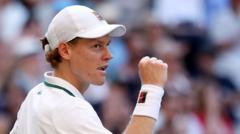
The grass courts of Wimbledon have become a familiar hunting ground for Jannik Sinner, who has now etched his name into the tournament's history by capturing back-to-back men's singles titles. In what proved to be a masterclass of efficiency and tactical acumen, the Italian sensation dismantled Alexander Zverev's determined challenge to retain his crown, reinforcing his position as the sport's preeminent player at a time when his rivals appear incapable of mounting sustained challenges against his varied arsenal and mental fortitude.
This championship represents far more than a simple repeat victory for Sinner. It symbolises a decisive shift in the contemporary landscape of professional tennis, where the youngest generation's representatives have begun to assert an iron grip on the sport's most prestigious tournaments. The All England Club has traditionally served as a stage where grass-court specialists and serve-and-volley practitioners once flourished, yet Sinner's consecutive triumphs suggest that the modern game's emphasis on baseline consistency, rapid ball striking, and adaptability has rendered grass a surface where all-court excellence ultimately prevails.
Zverev's Valiant Effort Falls Short
Alexander Zverev arrived at the championship with considerable motivation and recent form to suggest he possessed the weaponry necessary to dethrone the defending champion. The German competitor has long possessed the physical tools to compete at the highest level, boasting a powerful serve and commanding forehand stroke that have troubled elite opponents throughout his career. Yet against Sinner's unwavering consistency and seemingly inexhaustible capacity to retrieve and counter-attack, even Zverev's considerable talents proved insufficient. The match unfolded as a contest between Sinner's controlled aggression and Zverev's more orthodox power-based approach, with the champion's ability to dictate points from the baseline ultimately claiming the decisive edge.
The nature of Sinner's victory carries particular significance when examined through the lens of current competitive dynamics. Rather than merely outlasting Zverev through attrition, Sinner actively dominated proceedings through superior positioning, court awareness, and the capacity to construct points with surgical precision. This reflects the hallmark of his ascent through the professional ranks: not a reliance upon any single stroke or tactical element, but rather a comprehensive mastery of fundamentals executed at an extraordinarily high level.
Cementing an Era of Sinner Supremacy
With this triumph, Sinner has positioned himself not merely as a tournament winner but as the defining player of his era. The world number one ranking represents more than statistical achievement; it reflects a consistency across surfaces and competition that few players have managed to achieve in recent memory. From the hard courts where he first claimed Grand Slam honours to the grass courts of Wimbledon, Sinner has demonstrated the versatility required to sustain excellence across the calendar's most demanding schedule.
The significance of defending a Grand Slam title cannot be overstated in professional tennis. The pressure inherent in returning to a venue where one has previously triumphed brings unique psychological dimensions absent from initial victories. Opponents arrive with detailed match intelligence, studying footage obsessively and identifying potential tactical vulnerabilities. The media scrutiny intensifies, and the expectations from supporters and sponsors alike reach elevated levels. That Sinner navigated these headwinds while facing an opponent of Zverev's calibre speaks volumes regarding his mental resilience and the soundness of his preparation methodology.
This back-to-back championship success arrives at a pivotal moment in tennis's competitive structure. The sport has witnessed considerable player movement and strategic evolution in recent seasons, with emerging talents continuously challenging the established hierarchy. Yet Sinner's sustained excellence across multiple surfaces and tournaments demonstrates that genuine dominance—the kind that transforms a player into the sport's preeminent figure—requires not merely occasional brilliance but consistent, repeatable excellence at critical junctures.
Looking forward, Sinner's Wimbledon defence carries implications extending well beyond grass court season. His demonstrated capacity to maintain championship-level performance while defending titles establishes him as the opponent all rivals most fear confronting in Grand Slam environments. The mental burden of attempting to dethrone a dominant champion who has already proven capable of defeating the field grows exponentially with each successful defence, potentially creating a self-reinforcing cycle where Sinner's status as favourite intensifies with each tournament.
For tennis enthusiasts and analysts observing the sport's trajectory, this championship underscores a fundamental principle: sustained excellence at the professional level requires more than raw talent or physical capability. It demands intellectual sophistication in match strategy, psychological stability under extreme pressure, and the capacity for continuous improvement against opponents studying one's every movement. Sinner has demonstrated mastery of these intangibles alongside his undeniable technical abilities, creating a combination that currently appears virtually unbeatable when functioning at optimal levels.
As Sinner departs Wimbledon with another trophy and enhanced legacy credentials, the broader tennis community must confront an uncomfortable reality: the window for challengers to capitalize on perceived vulnerabilities appears to be closing. With each tournament victory, each set dominated, and each successful defence of a major title, Sinner constructs an increasingly formidable resume and psychological advantage over his competitors. His conquest of Zverev at Wimbledon represents not merely the conclusion of one tournament, but another significant chapter in what increasingly appears destined to become one of professional tennis's most dominant periods ever orchestrated by a single player.