Oda's Brilliance Ends Hewett's Wimbledon Dreams at All England Club
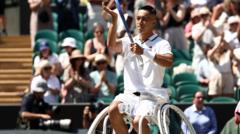
The manicured grass courts of the All England Lawn Tennis and Croquet Club witnessed a commanding performance on Saturday as Japan's Tokito Oda dismantled Great Britain's Alfie Hewett in the men's wheelchair singles final, securing a resounding 6-1, 6-1 victory. The match, played under the watchful gaze of Wimbledon's most devoted followers, saw the tournament's top seed deliver a near-flawless display of wheelchair tennis that left little room for his British challenger to mount any meaningful resistance. In just over an hour, Oda had claimed the prestigious title, etching his name alongside the sport's elite adaptive athletes.
For Hewett, the loss represented a significant missed opportunity to add another Grand Slam crown to his already impressive resume. The British player had navigated a challenging draw to reach the final, where he would face the formidable challenge of Oda at peak form. Hewett's journey through the tournament had demonstrated his credentials as one of wheelchair tennis's most accomplished competitors, yet on this particular afternoon, he encountered an opponent operating at an exceptional level. The scoreline—a double bagel—suggests a mismatch in execution rather than a reflection of Hewett's true capabilities, though it underscores the elite status Oda has established within the wheelchair singles ranks.
Oda's Ascendancy in Wheelchair Tennis
Tokito Oda's seeding as the tournament favourite was no arbitrary designation. The Japanese champion has become one of the sport's most consistent performers, combining technical excellence with mental fortitude that characterizes the game's elite practitioners. His path to the Wimbledon final had showcased the qualities that have elevated him to the top of the world rankings: acute court awareness, explosive racquet speed, and the capacity to construct points with intelligence and precision. Against Hewett, these attributes were on full display, with Oda controlling rallies from the opening service game and dictating the tempo throughout both sets.
The manner of Oda's victory—the emphatic nature of the scoreline—speaks volumes about his current standing in wheelchair tennis. To dismantle a player of Hewett's caliber without dropping a single game represents the kind of performance that defines careers and reshapes tournament narratives. Oda's dominance was methodical rather than theatrical, built upon the foundation of consistent execution and an unwillingness to gift his opponent any opening. Every service hold came with conviction; every break of serve felt inevitable. This is the tennis of a player who has studied his opponent, identified vulnerabilities, and systematized their exploitation.
Hewett's Struggle Against Overwhelming Pressure
Alfie Hewett arrived at the Wimbledon final as a proud representative of British wheelchair tennis, carrying the expectations of a nation that has developed a passionate following for adaptive sport at the grass-court citadel. The British player's previous accomplishments at Grand Slam tournaments have established him as a serious contender whenever he takes to any major stage. However, the pressure of performing on such an enormous platform—and against an opponent playing with Oda's efficiency—proved too much to overcome. The rapid unfolding of both sets suggested a player struggling to find rhythm, unable to impose his own game while simultaneously unable to withstand the relentless execution of his opponent.
In wheelchair tennis, as in the sport's conventional formats, momentum shifts can determine outcomes. Yet on this occasion, there was little momentum to shift. Oda established control early and methodically extended that dominance throughout the match. Hewett's service games became increasingly difficult to hold; his attempts to break serve yielded minimal opportunities. The psychological toll of losing games to love, watching set points accumulate, and finding no weakness to exploit—these are the experiences that define defeats of this magnitude. For Hewett, the challenge now lies in processing this experience and extracting whatever lessons might be gleaned from competing against an opponent performing at such a rarefied level.
Wimbledon's wheelchair tennis events have grown in stature and prestige considerably in recent years, reflecting the broader evolution of adaptive sport within mainstream consciousness. The championship has become a destination where wheelchair athletes compete for titles of genuine significance, played on the same hallowed grass that hosts tennis's most legendary figures. Oda's decisive victory adds another chapter to this narrative of growth and legitimacy, establishing him as a champion worthy of the tournament's rich history and demanding standards. His performance will likely be remembered not as a curiosity or a secondary event, but as a masterclass in professional tennis—a match where skill, preparation, and execution aligned to produce a triumph of undeniable quality.
As the tournament concluded and accolades were distributed, Oda's achievement resonated beyond the wheelchair tennis community. His Grand Slam title at Wimbledon represents validation of his status as one of the sport's premier athletes, regardless of classification or category. The trophy now joins his collection of honors, a tangible representation of excellence achieved on one of tennis's most demanding stages. For Hewett, the road forward involves reflection and renewed determination—the inevitable path of any competitor who has tasted defeat while striving for greatness. The 2024 Wimbledon men's wheelchair singles final will be remembered as the day Oda announced himself conclusively among the sport's champions, delivering a performance of such dominance that it transcended the specific match and spoke to something larger about excellence in athletic competition.