Hurkacz Derails Djokovic's Unstoppable Run with Shanghai Shock
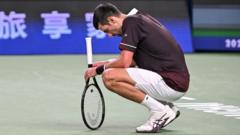
In one of the more jarring turns of fortune witnessed on the Asian hard court swing, Novak Djokovic found himself on the receiving end of a comprehensive defeat at the Shanghai Masters, falling to Poland's Hubert Hurkacz in a second-round encounter that has reverberated through the professional tennis landscape. What makes this setback particularly striking is its timing—coming merely seventy-two hours after the Serbian champion captured his crown at the China Open in Beijing, where he had demonstrated the kind of commanding form that has defined much of his career.
The loss represents far more than a simple tournament exit for Djokovic. It stands as a humbling reminder of tennis's inherent unpredictability, where momentum can evaporate with startling speed and confidence built across consecutive victories can crumble in a single afternoon. For Hurkacz, the triumph represents a significant scalp claimed against one of the sport's most decorated competitors, a validation of his continued evolution as a top-tier competitor on the professional circuit.
The Shanghai Setback: Timing and Context
The circumstances surrounding this defeat warrant careful examination. Djokovic's arrival in Shanghai came on the heels of a triumphant campaign in Beijing, where he had successfully navigated the draw and claimed yet another Masters 1000 title. This victory had reinforced his standing as the world's number one player and appeared to position him ideally for another strong showing at the Rolex Shanghai Masters, one of the year's most prestigious hard court events. The recovery period between events, though limited, would normally be considered adequate for a player of Djokovic's championship pedigree and physical conditioning.
Yet something shifted between those two competitions. Whether attributable to fatigue accumulated across the Asian swing, the intensity expended in Beijing, or simply Hurkacz bringing his absolute best tennis, Djokovic appeared unable to impose his typical authority on the court in Shanghai. The Pole's performance was sufficiently comprehensive to suggest this was not merely a matter of Djokovic underperforming marginally—rather, Hurkacz elevated his game to a level that proved insurmountable for even the sport's most successful contemporary player.
Hurkacz's Breakthrough Against the Elite
Hubert Hurkacz has steadily established himself as a player capable of challenging the sport's established hierarchy. The 27-year-old from Wrocław possesses the physical attributes and technical arsenal that can trouble anyone on the tour: a powerful serve that can generate free points, aggressive groundstrokes, and the athleticism to cover the court with impressive efficiency. However, converting these attributes into victories against the game's very best remains an inconsistent proposition, making this Shanghai triumph all the more significant for his trajectory.
Previous encounters between these two players had largely tilted in Djokovic's favor, as the numerical record would suggest. The Serbian champion's experience, competitive intelligence, and ability to adjust tactics mid-match have typically proven decisive against even formidable opponents. Hurkacz's success in Shanghai therefore represents a meaningful breakthrough, evidence that he has matured as a competitor and developed the mental fortitude required to execute tactical plans against elite opposition under tournament pressure. This victory will almost certainly provide psychological confidence as he continues his pursuit of a consistent place among tennis's upper echelon.
From a broader perspective, Hurkacz's triumph underscores a growing trend on the men's professional tour: the traditional gap separating the absolute elite from the next tier of competitors continues to narrow. Players with top-twenty rankings now possess sufficient quality to produce the occasional upset against the 'Big Three' or their contemporary successors. This democratization of elite tennis reflects improved training methods, greater professionalization throughout the sport, and the emergence of several technically gifted younger players who have grown up practicing against world-class competition.
The Shanghai Masters itself carries particular significance on the annual calendar. Held in the final weeks before the season's conclusion, the tournament attracts a stellar field and offers crucial ranking points for players vying for positioning in both the year-end standings and qualification for prestigious season-ending events. For Djokovic, the early exit represented an unexpected setback in his quest to accumulate additional ranking points and maintain momentum heading into the final stretch of the year. The loss also opened opportunities for other competitors in the draw, particularly those challenging for premium positioning in the rankings.
As the professional circuit moves forward, Djokovic will undoubtedly undertake the mental and analytical work necessary to dissect what transpired in Shanghai. Champions of his caliber possess the resilience to absorb losses, extract lessons, and return stronger in subsequent competitions. The question now centers on whether this defeat represents a minor stumble in an otherwise productive Asian campaign, or whether it signals the emergence of vulnerabilities that others on the tour will seek to exploit.
Meanwhile, Hurkacz will carry the confidence and momentum generated by this upset into future tournaments, particularly those contested on hard courts where his powerful serving game flourishes. Should he continue producing performances of similar caliber against elite opposition, he may finally establish himself as a genuine contender for Grand Slam titles and Masters 1000 trophies—the benchmarks by which professional tennis players ultimately measure their success. For now, his Shanghai victory stands as a defining moment in his career, a validation that at his best, he belongs in any conversation about tennis's upper echelon.