Krejcikova's Brilliance Ends Andreeva's Fairy Tale at the All England Club
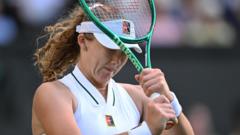
The weight of expectation can crush even the brightest emerging talents. Mirra Andreeva, who had captured the tennis world's imagination with her scintillating run to the French Open title earlier this season, found herself overwhelmed by emotion as she departed Wimbledon in shocking fashion. The teenage sensation was unable to contain her tears during the post-match press conference following a decisive defeat at the hands of Barbora Krejcikova, one of the sport's most decorated and experienced competitors. What had promised to be a coronation of sorts—a prodigious young champion competing on one of tennis's most hallowed stages—instead became a sobering reminder of how unforgiving the professional tour can be.
The contrast between Andreeva's clay court dominance and her grass court vulnerability proved to be the defining narrative of her Wimbledon campaign. Having recently claimed the prestigious French Open trophy, the rising Russian star arrived at the All England Club as one of the tournament's most compelling storylines. However, grass demands a fundamentally different approach than clay. The faster surface punishes the lengthy baseline exchanges that had served Andreeva so well on the red dirt of Roland Garros. Her typically methodical build-up of points, relying on precision and consistency, becomes obsolete when opponents can shorten points with aggressive net play and serve-and-volley tactics. Krejcikova, a player with decades of experience navigating these nuances, recognized this vulnerability and exploited it with clinical precision.
Experience Prevails Over Youth and Recent Glory
Barbora Krejcikova's triumph over Andreeva represented far more than a single match victory; it underscored the vast gulf that exists between winning a Grand Slam tournament and sustaining that success across different surfaces and circumstances. The Czech player, a multiple-time champion at the sport's biggest events and a master of doubles tennis, brought a portfolio of weapons perfectly suited to Wimbledon's demands. Her serve, her volleys, her court positioning—all elements honed through years of competing at the highest level—proved too much for Andreeva to manage. The young champion's game, for all its technical brilliance and shot-making acumen, still lacks the adaptability and defensive reserves required to compete against the tour's elite when conditions shift dramatically.
The emotional scenes that followed Andreeva's elimination spoke volumes about the mental and psychological demands of professional tennis at the elite level. Grand Slam tournaments, particularly one so recently won, carry immense emotional weight. The journey to a major title represents months of preparation, sacrifice, and singular focus. To have that momentum halted abruptly by a loss to a higher-ranked opponent on a surface that neutralized her strengths clearly took a considerable toll. Visible tears during the official press conference are comparatively rare in modern professional tennis, suggesting that Andreeva was grappling not merely with the result itself but with broader questions about her capacity to remain competitive across the various demands of the circuit.
The Grass Court Challenge: A Reckoning for the Next Generation
Wimbledon has long served as a proving ground where specialist knowledge and tactical flexibility determine outcomes as much as raw talent does. The grass courts reward aggressive play, punish errors more severely than forgiving clay, and demand that players possess an expansive arsenal of strokes. Young players ascending the rankings frequently discover that their junior-era techniques, refined and perfected on slower surfaces, require substantial modification to succeed on grass. For Andreeva, this adjustment represents an ongoing challenge rather than a temporary setback. Multiple tournaments, multiple seasons, and countless hours of practice on grass will be necessary before she can claim to be truly comfortable competing at Wimbledon's highest level.
Yet it would be premature to view this loss as a referendum on Andreeva's long-term career prospects. The teenage sensation has demonstrated exceptional talent and composure throughout her rapid rise through the rankings. Her French Open victory established her credentials as a serious contender for major trophies. What Wimbledon has instead provided is an education—perhaps the most valuable kind. She has learned that dominance in one sphere does not guarantee success in another, that opponents with superior experience can neutralize even the most technically sound games, and that professional tennis demands constant evolution and adaptation. These lessons, though delivered painfully, are precisely what separate those who enjoy temporary success from those who build lasting legacies.
The tennis world will be watching closely to see how Andreeva responds to this adversity in the weeks and months ahead. Her emotional response at Wimbledon, rather than a sign of fragility, may ultimately prove to be a strength. Champions are often defined not by their victories but by their capacity to absorb defeat, learn from it, and return stronger and more complete. Krejcikova's victory serves as a reminder that experience matters, that surfaces demand respect, and that the journey toward sustained excellence at the highest echelons of professional tennis is neither linear nor forgiving. For Andreeva, the path forward requires reflection, technical adjustment, and renewed determination to prove that her French Open success was merely the first chapter in a much longer story.